If corrective lenses are holding you back from living life to the fullest, you’re not alone. And while LASIK promises the vision but corrective lenses are holding you back from living life to the fullest, you’re not alone. While LASIK offers the freedom and clarity you dream of, we understand that surgery can feel like a big decision.
That’s why we created the No-Regrets LASIK Guide — a tool to empower you with the right questions to ask your provider. Plus, we’ve already answered them for you! Still have questions? Reach out anytime. We're here to ensure your peace of mind.
LASIK can improve nearsighted, farsighted, and astigmatic vision. But factors like age, eyeglass prescription, and even physical health impact your potential success and recovery.
Basic criteria include:
Choosing the best solution for your vision also requires an understanding of your lifestyle, visual demands, and hobbies. That’s why at Benjamin Eye Institute, we listen first. If LASIK isn’t the best solution for your situation, we’ll be honest with you—and then recommend other treatments better suited to your needs.
You’ll want a LASIK surgeon who has significant education, expertise, and experience with the procedure. But their knowledge shouldn’t begin and end with only LASIK. Why? Because, as the saying goes, if you’re a hammer, everything looks like a nail. When all a physician knows is LASIK, they’re less likely to consider other options that may serve you better.
To get a complete picture of a surgeon’s qualifications, ask:
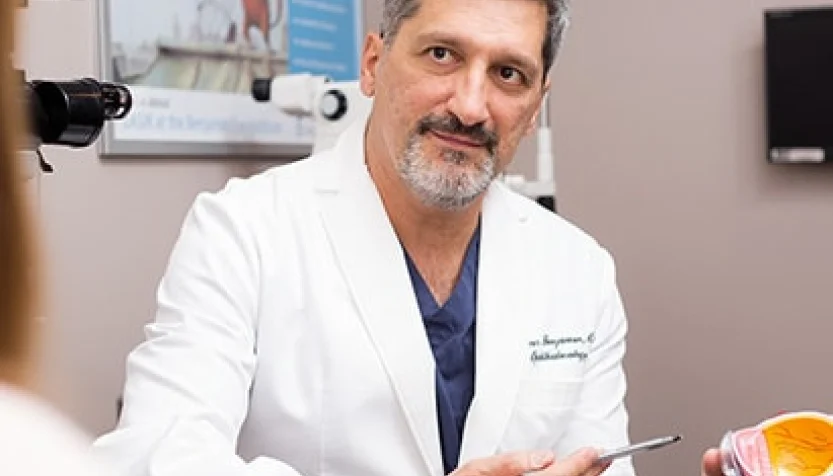
Dr. Benjamin holds degrees from Cornell University and Duke University School of Medicine. He acquired his ophthalmology training at the world-renowned Jules Stein Eye Institute at the UCLA School of Medicine.
Since 1994, Dr. Benjamin has seen more than 250,000 patients and has personally performed more than 30,000 ocular surgeries.
At Benjamin Eye Institute, we evaluate your concerns from every angle and offer thoughtful solutions that best protect your vision for life. In addition to LASIK, we offer cataract care, cosmetic treatments, dry eye treatment, glaucoma support, retina services, and general eye health.
Dr. Benjamin is a diplomate of the American Board of Ophthalmology, a member of both the California Association of Ophthalmology and the American Academy of Ophthalmology, serves on the leadership team for the American Society of Cataract and Refractive Surgeons. He also volunteers as an assistant clinical professor at the Jules Stein Eye Institute, where he teaches residents and medical students the latest surgical and medical advances in ophthalmology.
Other physicians not only frequently refer their patients to Dr. Benjamin, but they also trust him with their own eyesight. As a world-renowned ophthalmologist and eye surgeon, he has an unparalleled reputation as a “doctor’s doctor.”
The best LASIK providers value quality care over their bottom line—and their equipment and technology will reflect this priority. State-of-the-art diagnostic tools and advanced surgical lasers are worth the investment because they deliver the safest, most precise vision correction.
Unlike most LASIK providers, we own our diagnostic equipment and have an in-house surgical suite, which means everything is fine-tuned specifically and only for Dr. Benjamin. He has everything dialed in to perform his craft at his absolute best.
In addition, our advanced climate control protects the precision of our lasers, and our filtration system prevents bacteria from contaminating the environment. As a whole, our office is spotless, well-organized, and run by compassionate, patient-focused individuals.
We care about every aspect of your experience, so you never have to worry about mishaps or misunderstandings.
Your LASIK investment will depend on several factors, including the degree of vision correction required, the technology used, and the surgeon’s experience and skill.
While it may be tempting to choose a discounted version of LASIK, remember this procedure is irreversible. You truly can’t afford to choose cost over quality.
During your initial consultation at Benjamin Eye Institute, we’ll explain your treatment options and provide a detailed explanation of every related cost so there are no unpleasant surprises. For those who qualify, we offer 0% interest financing for two years through Care Credit, and our guarantee provides peace of mind that your investment will be worth it. (More on that in #5!)
When you receive LASIK from an expert physician who uses the most sophisticated technology available, you can expect your vision to be better than it was with your corrective lenses.
Occasionally, LASIK patients require an enhancement procedure within the first year post -surgery to fine-tune their vision.
But chances are, you won’t. Because Dr. Benjamin takes the time to accurately diagnose his patients upfront—and because he uses exceptionally precise equipment—only 1-3% of his patients require enhancement. That’s 5x lower than the industry average of 15%.
Don’t let your glasses and contacts hold you back from living your life to the fullest. Patients often say LASIK is the best decision they’ve ever made. Here are your next steps:
Take your next step toward being free to see!
Once upon a time, you probably went about most of your day, most days, not giving your eyes much thought. Like any vital organ—your heart, your lungs, your skin—your eyes just did their job without complaint.
Redness. Itchiness. Occasional blurriness. Irritation—like something’s in your eye all the time.
Suddenly, all you can think about is the fact that you have eyes. And they are angry. So you’ve been reaching for products that promise fast relief. Who wouldn’t? Dry eye is absolutely miserable!
But if you’re like most people, you now have a drugstore-sized collection of over-the-counter (OTC) eye drops. You’ve tried every “all-in-one,” “fast-acting,” “total comfort” drop out there—and nothing’s helping.
OTC eye drops simply can’t offer a complete solution.

What are tears, anyway? Tears are a viscoelastic structure. (Viscous fluids don’t flow easily and elastic fluids expand in all directions.) They’re made of three layers, and if the quality or quantity of any of the layers is disrupted, your tear film will be unstable—which is what leads to dry eye symptoms. :
In general, redness relief drops try to counter dry eye symptoms by increasing the amount of either oil or water. Why not both? Because, as you might recall from first-grade science class, oil and water don’t mix.
It’s simply not possible to have an “all-in-one” solution—so the best you can do is try drop after drop after drop until you find something that sorta-kinda works. It’s so frustrating!
But what about “artificial tears”?
Many artificial tears are better at offering lubrication than traditional eye drops. However, with excessive use, they can work too well—washing away your natural tears and/or the oil that prevents tears from evaporating. The result? More dry eye symptoms.
Before you put anything in your eyes, it’s best to consult with a qualified ophthalmologist.

Let’s have a quick (promise!) physiology lesson.
At the first sign of irritation, your eyes complain to your brain—and your brain responds by expanding the tiny blood vessels in your eyes to allow more blood flow and promote natural healing. This process, called vasodilation, makes those blood vessels more visible, which is why dry eyes appear red.
Here’s the problem: The active ingredient in “redness relief” drops is a vasoconstrictor, which means it instructs those blood vessels to clamp down again—preventing the very thing your eyes need to feel and look better. But that’s not all: With extended use, the blood vessels tend to dilate more when the vasoconstrictor wears off. And so you reach for your drops again. And again. And again.
This is called rebound hyperemia, and it sets up your poor eyes for nothing but misery.
The combination of contacts and redness-relief drops is particularly troublesome for a couple of reasons:
At best, redness relief drops only treat the symptoms of dry eye without treating the underlying cause.
And because we’re talking about your vision, it’s critical to understand what’s really behind it all.
Dry eye has multiple causes. Some are specific to your eyes, such as wearing contacts or recent LASIK surgery. Others are related to your overall health, such as hormonal changes associated with menopause or certain thyroid conditions. Environmental conditions (hello, Santa Ana winds!) and work requirements (spend much time on a computer?) can also contribute to dry eye.
In the vast majority of cases, dry eye will not resolve on its own. In fact, the condition gradually worsens over time—especially with excessive use of OTC eye drops. And in many cases, dry eye causes irreversible damage. That’s why early detection and intervention are so critical.
With the use of advanced diagnostic tools to identify the root cause and inform a clear path forward, your eyes can be kept healthy for the long term.
We know you want to look, feel, and see your best. That’s really tough to do when your eyes are red, irritated, and itchy. Life’s too short to put up with dry eye, and getting relief is easier than you think.
Even if you feel like you’ve tried everything, we can help.
You have undergone pterygium excision with conjunctival autograft or amniotic membrane graft. This procedure removes the abnormal fibrovascular tissue invading the cornea. Diligent UV protection and proper use of all prescribed medications are critical to prevent recurrence and ensure lasting clarity.
Dr. Benjamin has prescribed Prokera Slim — an FDA-cleared biological medical device that reduces inflammation, suppresses scarring, and restores the surface of your eye.
You have been prescribed treatment with the Valeda Light Delivery System because you have been diagnosed with dry age-related macular degeneration (AMD).
Congratulations on your procedure. Blepharoplasty rejuvenates the upper and/or lower eyelids by removing excess skin, fat, and muscle. Careful adherence to these instructions is essential for a safe recovery and the best possible aesthetic result.
Dr. Benjamin has prescribed Selective Laser Trabeculoplasty (SLT) — a modern, safe method of reducing intraocular pressure (IOP) in glaucoma and ocular hypertension. The landmark LiGHT trial showed that SLT is as effective as eye drops — and may offer superior long-term results.
Watching the Olympics earlier this month had me thinking about what could have been. Or at least what I dreamed about what could have been.
You see, between the ages of 12-14 I dreamed of becoming an Olympic diver someday. That is until my vision failed me. That is until I missed the end of the springboard attempting one of my patented jackknife dives and crashed into the edge of the board carving a neat chunk of skin out of the length of my back.
I begged my mom to let me wear my contacts to the pool, but these were the hard lenses days and replacing a hard lenses was an expense my single, working mom of three couldn’t afford. It wasn’t until years later I had the freedom of daily lenses and could get back on a spring board–my dream of being an Olympian long since tucked away in my hope chest.
Mine is a story that begs the question “how much more of our potential could we achieve with corrected vision?” I like to think I would have kept diving, eventually making my high school varsity team, then perhaps a scholarship to college. And who knows, eventually I might have earned a spot on the U.S. Olympic team?
Perhaps you don’t dream of making the Olympics. Perhaps it’s just that you’re having less fun because of impaired vision.
What activity do you shy away from because you wear eyeglasses? Is it hot yoga? Can’t have those glasses slipping down your nose during your forward folds, right? Basketball? One elbow to the head and there go your expensive frames? Perhaps, like me, you gave up some loved past time like swimming, gymnastics, or surfing because it just didn’t pair well with eyeglasses.
Whatever your sport, whatever your excuse, it doesn’t have to be that way.
Of course, contact lenses are always an option. And in the case of one Olympian, may have been the best option. However, when you calculate the difference between LASIK surgery costs and the cost of wearing glasses and/or contacts over a lifetime, you quite likely will decide for LASIK surgery. Over an average lifespan, contact lenses could cost a 20 year-old up to $30,000, not including eye exams and eyeglass prescriptions. Accordingly, LASIK surgery pays for itself in as little as three years.
Is today the day you’ll return to an activity you gave up due to wearing eyeglasses? If not today, then when? The first step is easy. Schedule your consultation with Benjamin Eye Institute today. Find out what you’re missing. Find your passion…again!
What is LASIK?
LASIK (Laser-Assisted In Situ Keratomileusis) is a minimally invasive procedure that reshapes the cornea to correct vision problems such as nearsightedness, farsightedness, and astigmatism. It’s fast, effective, and often eliminates the need for corrective lenses entirely.
Why Consider LASIK?
Here’s what makes LASIK at Benjamin Eye Institute a trusted choice:
💎 30+ Years of Expertise:
Dr. Arthur Benjamin, a renowned ophthalmologist, has dedicated decades to perfecting vision correction procedures, ensuring the highest standards of care and outcomes.
💎 Advanced Technology:
Our LASIK procedures utilize cutting-edge equipment to provide precise, safe, and effective results tailored to each patient’s unique needs.
💎 A World-Class Team:
From consultation to post-operative care, our experienced and compassionate professionals guide you every step of the way.
If you’re ready to explore LASIK or simply want to learn more, let us help you take the first step.
📞 Call or text us at 310.275.5533 to schedule your LASIK consultation today.
Your vision is in expert hands.